Saturday, February 14, 2009

Indonesian Tattoos Gallery


About 2.500 before Christ old Malayan people from the asian mainland colonized the Indonesian archipelago. In the second part of the first century before Christ the immigration from southern China came and around the turning point in history the colonization from people from India started who brought buddhistic and hinduistic ideas with them including the art of the religious tattoo.

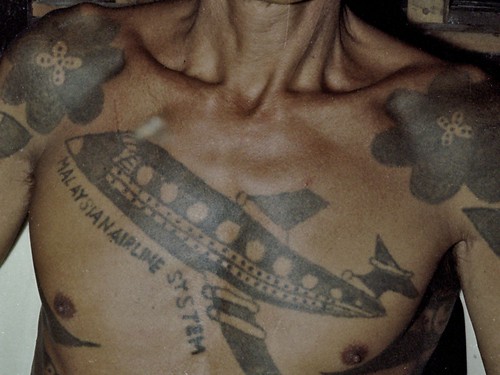
The people of Indonesia believed the soul of a human can only feel at home if the body is completed by decorations on the skin. Therefore the so called Titi spiral markings were tataued on hands, forearms and lower legs at a certain age. In addition men also often received a sinuous chest shield reaching as far up as the cheeks. The tatau equipment was a wooden sledge and a grip made from deer horn with a brass needle. A petroleum grime containing color was spread on the brass needle and the pattern, which was first drawn on the particular body part, was grated into the skin. The skin art survived the colonization of the Europeans after the discovery of the sea route to India in 1498.

Until today it is almost impossible to tell how many of the 20.000 Indonesian islands between Asia and Australia are even inhabited. The current estimate is around 6.000. Not until the declaration of independence of Indonesia in 1954 the tattooing and also the traditional peak chiseling of the teeth was prohibited by the government. Only on a few islands the tradition of body art is still preponderance since then. Especially the island of Borneo kept up the tradition of the tatau as independent and world wide recognized art form.


Source : http://tattoojoy.com/tattoo_history/indonesia.php

Indonesian Tattoos and Body Art


Indonesians, Javanese in particular, used to take tattoos as synonymous with incurable criminal tendencies. In 1980's, there was a controversial police biz all around Java -- it wasn't really recognized as such, as a matter of course, by the regime in power at the time -- that involved rounding up nearly everybody with a tattoo on his body, and shooting them on the spot. This was supposed to prevent crimes before any was committed. No kidding.

Because not a single tentacle of 'the Authorities' acknowledged the 'signature' on this spree as theirs, the thing stays in the Indonesian history as the times of 'Petrus' -- that's the Indonesian and Javanese version of 'Peter' (by the way, click here for Indonesian names), but in this case it was an abbreviation of the term 'penembak misterius', i.e. 'mystery shooters'.

Ten years after those scary days, in the end of 1990's, tattoo parlors owned, managed and operated by twentysomethings became familiar sights in Java -- especially in Bandung (West Java), Jakarta (capital city of this Republic), Yogya, and Surabaya (East Java)

Those come in a variety of everything.

I mean, the tattoo artists of some joints are really great and do their jobs professionally, some others are freelancers obeying whims, or even overzealous yet underachieving amateurs.

The joints themselves range from some air-conditioned hygienic rooms with some music (like Hitam in Yogya), to a simple one-room place not dissimilar with the characteristic Indonesian cigarette vending carts, down to just any spot on earth that happens to be where the artist and the client meets.

Anyway, these joints, even if some are nothing like biz and closer to 'communities', have been helping to elevate the status of tattoo in this country. Of course Hollywood plays some significant parts, too, in changing the average Indonesian minds about the dignity of such permanent (or, after 2000, also temporary) body-painting.

As in any pioneering and edge-cutting enterprise, certain individuals can get nailed down as the ones who have been doing much to attain today's lively tattoo-related scene accessible to all.


Source : http://www.geocities.com/omimachi2/art6.htm

The Tattoos Artist Profile


I was always into tattoos. All my father's friends had Vietnam shit and I would stare at them as a little kid. I thought it was the coolest. I couldn't wait to get one.
I am into traditional American. One point tattoos, old school, new school but I also dig Japanese. I really don't have one favorite - more like one least favorite.....TRIBAL.
Tattoo Artists That Have Inspired You Most: Ed hardy, Martin lacasse, Horiyoshi lll, Mike Rubendall, Kore Flatmo
Secular Artists That Have Inspired You Most: Picasso, Dali
Other Hobbies and Interests: I no longer have any other interests. Tattooing is my life.
How and Where to Contact You: The Devil's Den
1265 Montauk Hwy
Copiague, NY 11726
631-225-6523
www.longislandtattoo.com
www.joeblacktattoo.com
www.tattoonow.com
Words of Wisdom from Joe Ferzola: If someone is thinking about learning to tattoo, study up on it before you start. Practice drawing tattoos not drawings!!! Understand what a tattoo is made up of. And have some balls and tattoo yourself first.

If someone is looking to get a tattoo, shop around, look at as many portflios as you can - go online, find a style that you are interested in and talk to your artist, be specific in what it is that you want and have them draw a sketch for you. That usally requires a down payment - but that shit is going on your body for the rest of your life so....smarten up!


Source : http://tattoo.about.com/od/usstudionewyork/p/joeferzola.htm

The Tattoos Aesthetic


It has been several years since even Ozzy Osbourne could see that tattoos were overexposed: “To be unique, don’t get a tattoo. Because everybody else has got tattoos!” Yet despite the fact that tattoo imagery is everywhere — serving as the basis for reality shows, as a de facto part of N.B.A. uniforms and, increasingly, as an element in marketing — it retains its appeal as “an authentic and real part of culture,” one advertising executive recently informed The Chicago Tribune. What’s surprising about the popularity of tattooing is that it won’t seem to go away — that some tattoo imagery still seems authentic, even when it’s mainstream.

Scott Campbell learned the tattoo trade in San Francisco, starting at a “scratcher” shop there before spending several years in Europe and, eventually, New York. He studied the history and lore of tattooing, learning the classic, old-school styles of Norman (Sailor Jerry) Collins and others, and adding his own twists. In 2004 he opened his own shop, Saved Tattoo, in Brooklyn. Set up like a boutique, it has clients that include ad-agency art directors and people like Marc Jacobs and Heath Ledger. Still, Campbell loves the “romance” of the now-gone two-fisted clamor of the Honolulu Chinatown district where Sailor Jerry made his name, when a tattoo was a mark of something quite the opposite of hip fashion. “The stories are amazing,” he says. “You wish it was 1950 again — and you were that tough.”

In 2005, Campbell was approached by Gyro Worldwide, a Philadelphia ad firm, to create art for a campaign on behalf of Camel cigarettes. It wasn’t his first brush with marketing, but it was his most significant: his poster designs all carried his signature, and they led to work on behalf of Nike, Volkswagen and other brands. He’s creating artwork for ZZ Top’s tour merchandise, and recently a bunch of Comcast executives visited his tattoo parlor to talk about the work he’s doing for their new Fearnet channel.

Campbell and some of the other young tattoo artists who contributed to the Camel campaign also did some designs for Sailor Jerry. Not the man, who died in 1973, but the apparel brand, which was founded in 1999. The owners of the Sailor Jerry brand lean heavily on the idea of authenticity: its owners secured the rights to use his images on clothes and accessories from the two Sailor Jerry protégés to whom he left his estate. Promoted in venues like tattoo conventions, and with advertising that runs to the squalid and debauched, its sales are around $16 million a year. There’s also Sailor Jerry rum — 92 proof, and more likely to be found in a red-state biker bar than in a trendy lounge — and a Sailor Jerry documentary on the way. But this is where the tattoo/authenticity/marketing nexus gets weedy. The Sailor Jerry brand is owned by Gyro, the ad agency that hired Campbell to work for Camel.

Apart from serving as a kind of alternative-marketing skunk works for the agency, Sailor Jerry has attained a strong-enough identity to land a co-branding deal with Converse, which has released more than a dozen models of Sailor Jerry sneakers in the last couple of years. (The deal is strictly about Sailor Jerry; Converse does not use Gyro as its ad agency.) Steven Grasse, Gyro’s chief executive, says the Sailor Jerry brand has earned its place precisely because of the (authentic) way Gyro has built it.

And thus marketing becomes not a leech on tattoo culture, but an arbiter of it. Grasse hired Campbell, for instance, because he liked the way Campbell’s work fit into a tattoo style that he considers analogous to American folk art, and something else: “What we notice with tattoo artists, versus other kinds of indie artists, is that tattoo artists like making money. It’s their business.”

The Camel campaign “opened my eyes,” Campbell says. “I made phenomenal money watercoloring these same pictures I’d been tattooing on people.” Lately he has been applying his aesthetic to household objects by way of a laser-etching machine, and formed his own creative agency, Mama Tried, so he can work with new clients “from the concepting stage,” consulting on a brand’s entire image, rather than just doing illustrations. When I spoke to Campbell, he had just finished a pitch that would involve working with Gyro on a new alcohol brand. Admittedly, all of this means that he has others to handle the customers at his boutique now. There’s one thing Campbell just doesn’t have much time for these days: actual tattooing.


Source : http://www.nytimes.com/2007/04/22/magazine/22wwlnconsumed.t.html?_r=1